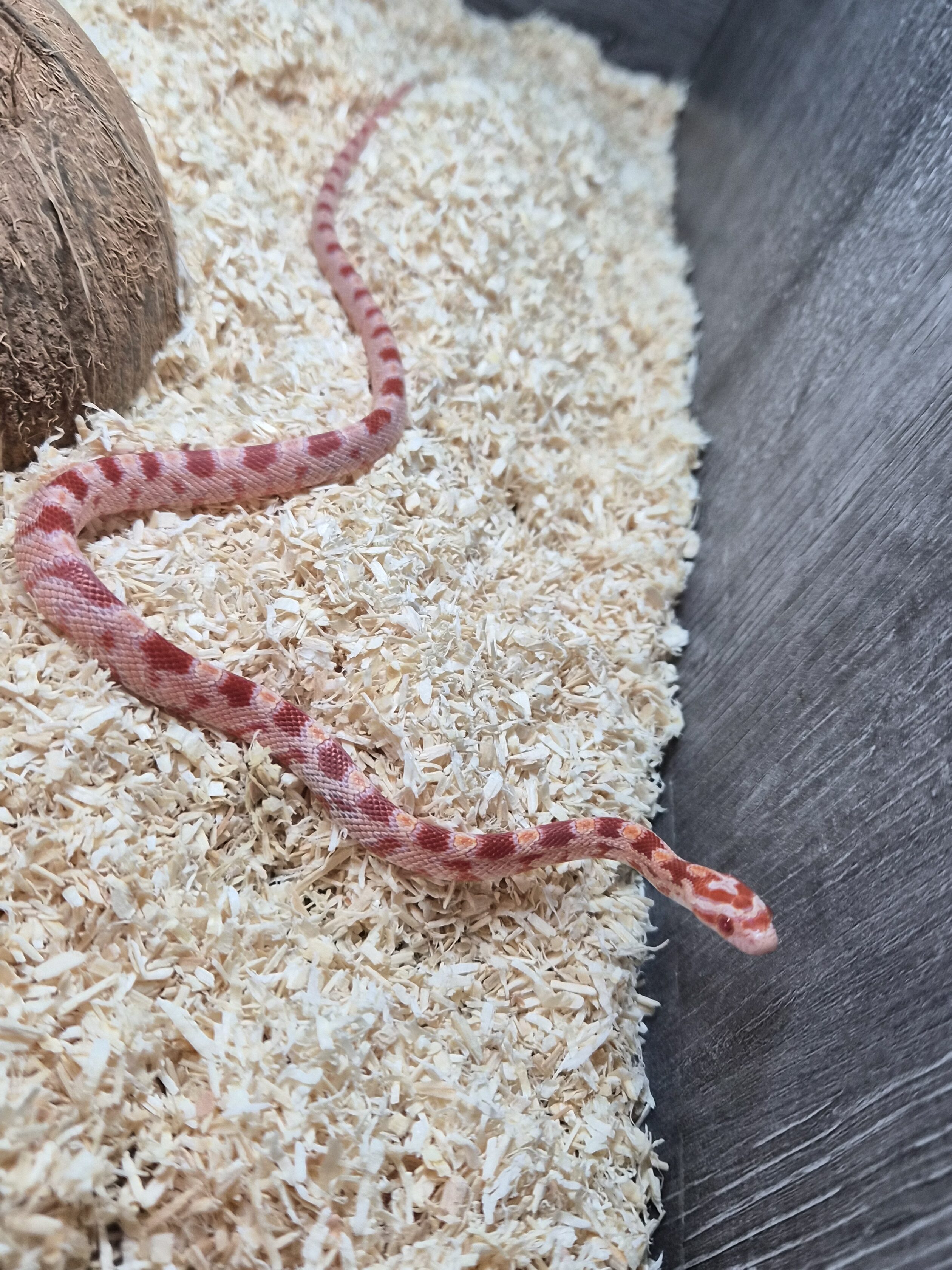
Corn Snake (Pantherophis guttatus) originates from the southeastern and central United States, with its native range stretching from southern New Jersey down to the Florida Keys and westward into parts of Louisiana.
Housing & Enclosure
- Minimum Size: Hatchlings can start in a smaller enclosure or a 20-gallon tank, while adult corn snakes require at least a 40-to-75-gallon tank or a 4ft x 2ft x 2ft (120x60x60cm) wooden or glass vivarium. The enclosure must be completely escape-proof with secure locks.
- Substrate: Use safe beddings like aspen shavings, coconut husk, or a soil-mix. Avoid cedar, pine, or sand.
- Furnishings: Provide at least two hiding spots (one on the warm side, one on the cool side), climbing branches, and foliage for enrichment.
Temperature & Lighting
- Thermal Gradient: Create a warm basking zone and a cooler side so the snake can regulate its body temperature.
-
- Basking spot: ~85°F to 90°F (29°C to 32°C)
- Cool side: ~72°F to 78°F (22°C to 26°C)
-
- Heating Sources: Use overhead heat bulbs, ceramic heat emitters, or a deep heat projector controlled by a thermostat. Night time temperatures can safely drop a bit, provided the room stays above 70°F (or use a low-level night heat source if needed).
- Lighting: Provide a low-output UVB (1.0–3.0 UVI or 2-5% T5 tube) for 10 to 12 hours a day to mimic a natural day/night cycle.
Humidity & Water
- Humidity Level: Maintain ambient humidity between 40% and 60%, rising to around 70%–85% or providing a damp humid hide (stuffed with moist sphagnum moss) to assist during shedding. According to general community consensus on Reddit, keeping humidity steady around 55% helps prevent respiratory issues or bad sheds.
- Water: Always provide a heavy, clean water dish large enough for the snake to soak in if it chooses, and refresh the water daily.
Diet & Feeding
- Prey: Carnivorous constrictors that eat pre-killed/frozen-thawed rodents (mice or small rats). Never feed live mice, as they can injure your snake.
- Frequency:
-
- Hatchlings/Juveniles: Feed every 5 to 7 days (starting with small “pinky” mice).
- Adults: Feed every 10 to 14 days depending on body condition and size.
-
- Rule of Thumb: Choose a mouse width slightly larger than the widest part of the snake’s midsection. Feed inside the enclosure using tongs, and avoid handling the snake for 48 hours after a meal.